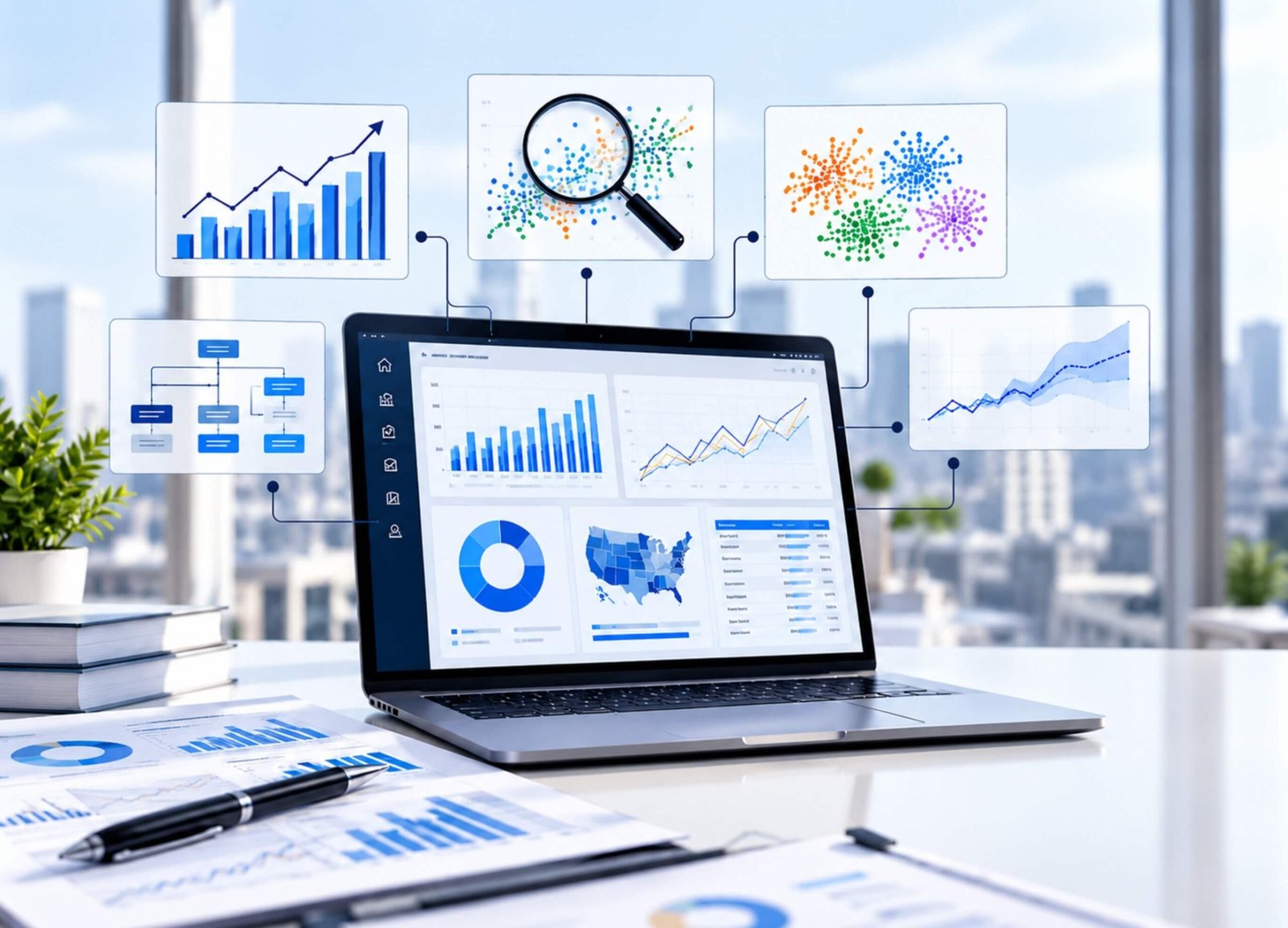
In today’s competitive business environment, organizations generate large volumes of data through customer interactions, sales transactions, marketing campaigns, operational activities, and digital platforms. However, collecting data alone does not guarantee better results. Businesses need to interpret this information to identify patterns, understand performance, and make informed decisions. This is where data analysis services become essential.
Data analysis transforms raw information into meaningful insights that help organizations solve problems, improve productivity, understand customer behavior, and identify opportunities for growth. Whether a business operates in healthcare, finance, retail, manufacturing, or technology, effective data analysis service supports smarter and more strategic decision-making.
What is Data Analysis?
Data analysis is the systematic process of collecting, cleaning, organizing, examining, and interpreting data to discover useful information and support decision-making. It involves using statistical methods, analytical techniques, and digital tools to identify trends, relationships, patterns, and anomalies within datasets.
For example, an e-commerce company can analyze sales records to determine which products generate the most revenue, which marketing channels attract customers, and during which periods demand increases. These insights help the company optimize inventory, improve marketing campaigns, and plan future sales activities. Analysis of data can be performed using tools such as Microsoft Excel, SQL, Python, Tableau, and Microsoft Power BI, depending on the complexity of the data and the business objectives.
Why is Data Analysis Important?
In the world where data is generated in unaccountable volume, extracting insights and Data analysis plays a significant role in helping organizations understand their current performance and plan for the future. Its importance extends across several business functions.
Supports Data-Driven Decision-Making
Business decisions based solely on assumptions may lead to unnecessary risks. Data analysis services provide measurable evidence that helps managers evaluate alternatives and make informed choices. For instance, analyzing customer feedback, sales figures, and market demand can help a business decide which products to prioritize or which services require improvement.
Improves Operational Efficiency
Analyzing operational data helps businesses identify repetitive tasks, workflow delays, resource shortages, and inefficient processes. Organizations can use these insights to streamline operations, reduce manual work, and improve productivity. Manufacturing companies, for example, can analyze production data to identify recurring equipment failures and investigate the causes of downtime.
Enhances Customer Understanding
Businesses can analyze customer demographics, purchasing behavior, feedback, and engagement patterns to understand what their audiences need. These insights enable organizations to personalize communication, improve customer experiences, develop relevant products, and build stronger customer relationships.
Identifies Trends and Opportunities
Historical and current data can reveal changes in demand, customer preferences, and market behavior. Recognizing these patterns helps businesses identify potential opportunities and respond to emerging challenges. For example, a retailer may discover increasing demand for a particular product category and adjust its inventory and promotional strategy accordingly.
Reduces Costs and Business Risks
Data analysis helps organizations identify unnecessary expenditure, detect unusual transactions, and evaluate potential risks. Financial and operational analysis can highlight where resources are being wasted and where corrective action may be required. However, analytical results should be combined with professional judgment and appropriate risk controls rather than treated as guarantees.
Measure Business Performance
Organizations use KPIs to measure progress toward business objectives. Data analysis helps track revenue, conversion rates, customer retention, operational costs, and employee productivity. Dashboards and periodic reports make these metrics easier to understand, allowing managers to monitor performance and identify areas requiring attention.
What Are the Main Types of Data Analysis?
The importance of data analysis is undeniable; however, businesses use its power differently depending on their needs and objectives. Types of data analysis can be divided into four widely used cases, descriptive, diagnostic, predictive, and prescriptive analysis. Each data analysis type addresses a different business requirement and fulfills its objective.
Descriptive Analysis
Descriptive analysis explains what has happened by summarizing historical data into understandable information. It uses reports, averages, percentages, charts, and dashboards to present performance and highlight patterns.
- Common tools: Microsoft Excel, Power BI, Tableau, and SQL.
- Business benefit: Helps organizations understand past performance and establish a baseline for further analysis.
Diagnostic Analysis
Diagnostic analysis investigates why something happened. It examines relationships, compares variables, and explores possible causes behind observed outcomes. Techniques may include drill-down analysis, segmentation, correlation analysis, and root-cause investigation.
- Common tools: SQL, Excel, Python, and business intelligence platforms.
- Business benefit: Helps organizations investigate performance problems and identify areas for corrective action. Correlation alone, however, does not prove causation.
Predictive Analysis
Predictive analysis uses historical data, statistical techniques, and machine learning models to estimate future outcomes or the likelihood of particular events. Its accuracy depends on data quality, appropriate modeling, and whether historical patterns remain relevant.
- Common tools: Python, R, statistical software, and machine learning platforms.
- Business benefit: Supports demand forecasting, resource planning, customer retention strategies, and risk assessment.
Prescriptive Analysis
Prescriptive analysis recommends possible actions based on data, forecasts, business constraints, and defined objectives. It may use optimization techniques, simulations, and decision models to compare alternatives.
- Common tools: Python optimization libraries, advanced analytics platforms, and specialized decision-support software.
- Business benefit: Helps organizations evaluate alternatives and choose actions that align with their objectives and constraints.
Conclusion
Data analysis is an essential business capability that transforms raw data into actionable insights. It helps organizations understand past performance, investigate problems, estimate future outcomes, and evaluate possible actions. By combining reliable data, appropriate tools, and sound professional judgment, businesses can improve operational efficiency, manage risks, understand customers, and make more informed decisions.
FAQ

What is the main purpose of data analysis?
The main purpose of data analysis is to transform raw data into meaningful insights that support informed decision-making, problem-solving, performance measurement, and business improvement.
What are the four main types of data analysis?
The four main types are descriptive analysis, diagnostic analysis, predictive analysis, and prescriptive analysis. They explain what happened, why it happened, what may happen next, and what actions could be taken.
Which tools are commonly used for data analysis?
Common tools include Microsoft Excel, SQL, Python, R, Tableau, and Microsoft Power BI. The appropriate tool depends on dataset size, analytical complexity, reporting requirements, and available technical skills.
How does data analysis help businesses make better decisions?
Data analysis services help businesses identify trends, measure performance, evaluate alternatives, understand customer behavior, and investigate operational problems enabling strategic decisions.
Why is data cleaning important in data analysis?
Data cleaning helps identify and address missing values, duplicate records, inconsistent formats, and errors. Better data quality improves the reliability of analysis and reduces the risk of misleading conclusions.
Can small businesses benefit from data analysis?
Yes. Small businesses can analyze sales, expenses, customer feedback, website traffic, and inventory using accessible tools such as Excel and Power BI. Even basic analysis can help identify opportunities to improve efficiency and customer satisfaction.