
Shopping online has become almost a daily practice for us. From sales to having privileges as a special customer, the online shopping experience has improved since it was launched in the market. With rapid growth in digitalization, the market exploded with the online shopping concept, enabling customers to buy products from websites from the comfort of their homes. Today, this has become a significant part of life, and now customers can leverage 10-minute delivery, called quick ecommerce. Shopping from the comfort of our homes and easy payments have encouraged customers to buy online. Not only this, but ecommerce has enabled customers to compare and select.
Traditional shopping has slowly been replaced by creative ecommerce websites, a variety of products in one place, price comparisons, online offers, doorstep delivery, easy payment modes, and more. Usually, traditional shopping is time-consuming: customers have to roam from shop to shop, there are no exchange policies in shops, and more. With ecommerce rise of e-commerce, shopping has become a convenient and fun experience. Although it is a question of how these product-based websites work? Have you ever thought that when searching for a product, let’s say, “blue tops for women”, how easily the site brings all the blue tops for women in the filtered category?
Moreover, the continuous growth of the economy has led shoppers and customers to expect intelligent search results, personalized recommendations, a seamless experience, and instant access to exactly what they desire. In the modern digital landscape, ecommerce has adopted the latest trends and approaches to deliver and fulfil the demands of customers. In today’s era, setting up an ecommerce business is easy, but ensuring it runs smoothly requires robust backend processes.
In simple words, an ecommerce business must have accurate backend operations that include data management, data processing, image enhancement, and data annotation services. Every ecommerce business, big or small, demands precise data management, as it handles a variety of datasets, including product descriptions, image data, product listings, stock inventory, and more. With consistent growth and innovation, the emergence of artificial intelligence now plays a significant role even in the ecommerce industry.
Therefore, retail AI data labelling and the integration of annotation and other key technologies not only enhance the ecommerce business but also enable the delivery of a personalized, seamless, and satisfying experience. As a matter of fact, data annotation for ecommerce approaches is now a key to business success, enabling customer attraction and even staying ahead of the market curve.
Moreover, ecommerce is the sector where data is the key to success, and even in retail. With significant technological changes and integrations, ecommerce annotation services are no longer a novel approach but a necessity to sustain the competitive market. Let’s get a quick overview of what data annotation services are and how it has become a vital aspect in ecommerce and retail.
Upscale Ecommerce Operations with Data Annotation
Understanding Data Annotation in Detail
In the digital landscape of business, data is a crucial resource that enables professionals to make data-driven decisions, ensure streamlined operations, and stay ahead of the competition. However this is the end goal as the technology and innovation continues to advance, introducing AI and ML in aspect. Today, AI is everywhere, from our smartphones to our TVs and even our refrigerators. The consistent growth of AI has made our lives simpler and easier, saving time. But have you ever thought about how an AI model works and showcases the accurate answer?
Well, the overall answer to this is to feed structured and trained data to the AI and ML model for self-learning, understanding, and providing human-oriented answers. Not only this, AI capabilities are based on structured, trained data that help the model understand images, text, audio, and video. Moreover, different types of data formats are segregated for clarity. As a matter of fact, to feed the model with relevant information and deliver output, the data must be accurate, efficient, aggregated, tagged, and identified by the model.
This process of tagging, labeling, or attributing data is called data annotation services. In simple terms, it is the process of labeling or annotating data with different metadata, such as audio, text, and images, to train ML models for chatbots, virtual assistants, self-driving cars, and more. The ML algorithm learns from the fed database to generate human-oriented answers.
For example, the healthcare sector adopted a data annotation approach to label X-rays, CT scans, and other reports, enabling models to identify precise abnormalities and pinpoint their exact locations in the scans. Similarly, voice or virtual assistants work similarly with accurately trained and annotated data to understand accents, languages, and emotions, as the demand for data annotation has increased due to the rapid growth of AI and ML models.
AI has spread across various sectors like wildfire and has now become an essential aspect in the competitive, dynamic realm. Therefore, retail AI data labeling, or per se, ecommerce data annotation, is now a crucial part of the industry. Explore in detail how it is an evident approach for the ecommerce business landscape.
Significance of Data Annotation in Ecommerce
The global ecommerce market has grown rapidly. Shopping from the comfort of our homes was once something unimaginable. However, today we all tend to digitally window-shop and buy the products we want easily, without making the effort to visit different shops. In the industry, Amazon is one of the biggest, renowned, and reliable marketplaces where customers can find products as desired, with price comparisons, different shapes, colors, sizes, customer reviews with star ratings, photos, and more.
Being the biggest marketplace in the ecommerce sector, it is evident to understand the continuous growth and how technology integration can impact the ecommerce sector. Modern technologies, such as AI and ML integration, have driven rapid growth, a seamless customer experience, and a rise in online shopping. As a matter of fact, the future of ecommerce is bright with product data annotation services. The growth and increasing dependency on online shopping, data annotation is the process of labeling for training ML and computer vision.
Annotated, structured, and clean data helps to develop AI that understands, classifies, and categorizes product information. Since the ecommerce sector is continually evolving, high-quality data enables it to capture customers’ attention, which is a key part of ecommerce business success. Data annotation brings a variety of benefits for ecommerce, including;
Key Advantages of Data Annotation
Increased brand visibility
Personalized experience
Enhanced inventory management
Improved product reach
Data-driven decision
Better customer service
These are some of the key benefits of data annotation for ecommerce, as it enables firms to excel in the market and bring the required customer desire. Moreover, there are usually types of data annotation involved in the retail and ecommerce sector, including;
- User behaviour and interaction data
- Product attributes
- Text description
- Customer reviews
- Product images and videos
The current state of the ecommerce market is rapidly growing. It also heavily relies on AI-powered systems, generating chatbots and dynamic pricing for articles and products. Data annotation services have become an indispensable approach for delivering a seamless, personalized, and efficient shopping experience. As ecommerce is a vast sector, there are a variety of applications of data annotation, discovering them in detail.
Applications of Data Annotation in the Ecommerce Sector
The key significance of data annotation in retail is briefly discussed above, highlighting its benefits. Additionally, ecommerce isn’t just about buying and selling; it goes beyond that. There are various aspects of ecommerce where product data annotation services, image annotation, video annotation, and more play an important role. With accurate, efficient data labelling, customers can enjoy a seamless shopping experience and receive precise recommendations. Hence, there are multiple applications of retail AI data labeling, as follows;
Data annotation Use Cases in Ecommerce
Visual search and image recognition
Chatbots and virtual assistants
Sentiment analysis
Price optimization
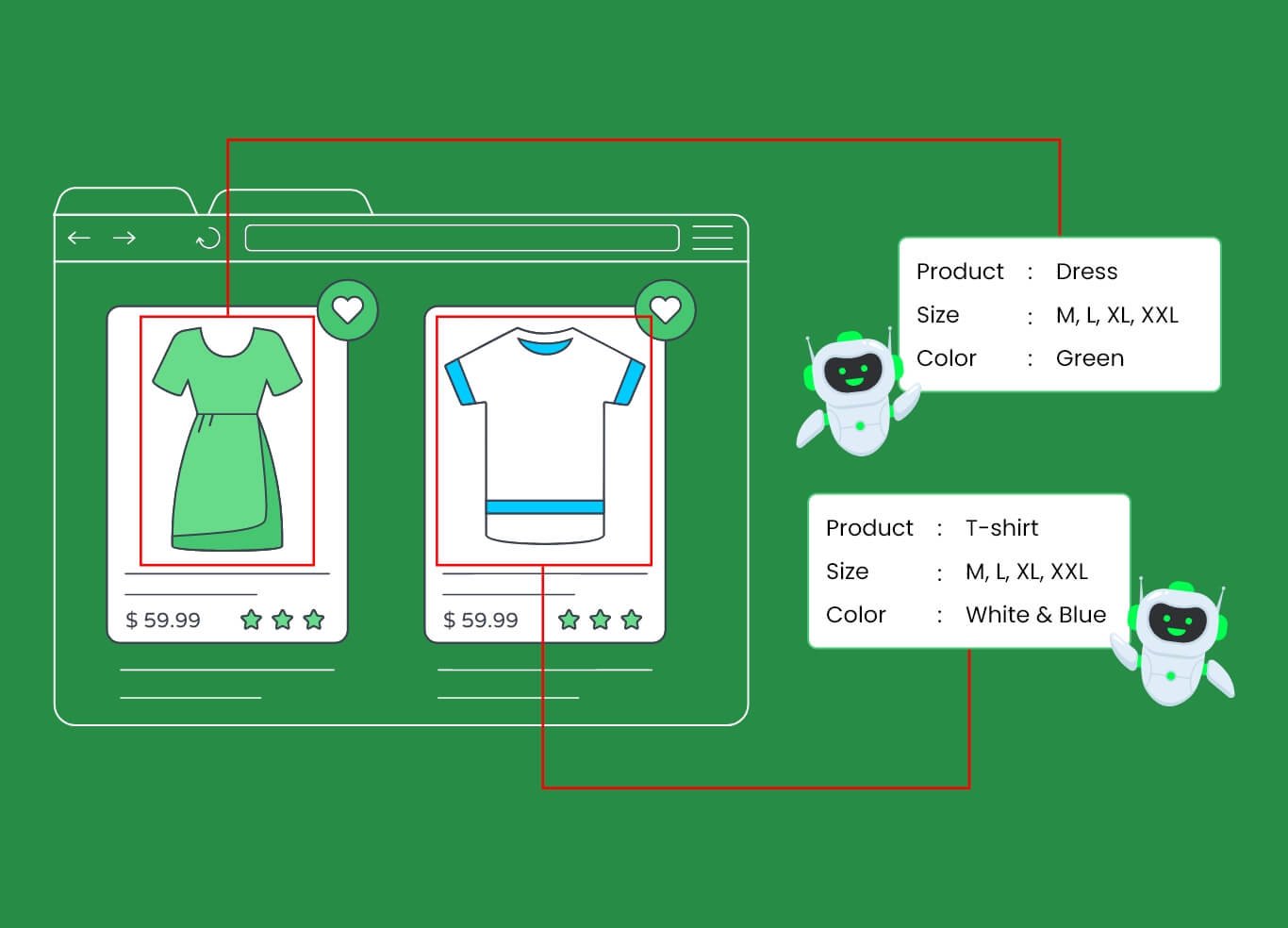
- Visual search and image recognition: With the continuous rise of the ecommerce industry, visual search for products has become a vital aspect. Retail data annotation enables AI and ML models to recognize product images and categorize them for easier customer search. Here, the image annotation outsourcing service delivers the desired results, allowing quick product finding on the site using an image. For example, searching for a product on Myntra is easier with visual search. Taking a bottle picture with a search bar camera and uploading it enables AI to showcase results for a similar product. Hence, image annotation is a game-changer.
- Sentiment analysis: One of the primary key points for ecommerce success is sentiment analysis, which means understanding your audience. By analyzing customer reviews, data, and feedback, ecommerce business professionals can identify sentiment trends and address issues promptly. This allows professionals to improve customer satisfaction, build brand reputation, build a regular customer chain, stay ahead of the market curve, and more.
- Chatbots and virtual assistants: Ecommerce AI training data is essential, that also includes chatbots and virtual assistants. These AI-powered software and tools offer quick resolutions to customer queries instantly. Annotated or labelled data ensures that these tools can understand human-oriented chats, provide precise responses, and fulfill customers’ needs.
- Price optimization: It is one of the most significant aspects for any ecommerce business. With data annotation for ecommerce, retailers or professionals can monitor prices, develop data-driven pricing strategies, and understand market trends. AI models can enable optimal pricing strategies and maximize profits while remaining competitive.
As these are some of the major applications of data annotation for ecommerce, it will continue to evolve as technology advances, just as we see Netflix recommendations based on previous viewing, with the backend and accurate data annotation playing significant roles. However, as a vital aspect, it isn’t as easy as it sounds. Therefore, to ensure efficiency and accuracy, partnering with data annotation service providers is a comprehensive approach that enables ecommerce firms to have hands-on experts using the latest technology.
Outsourcing enables increased productivity, a focus on core tasks, and helps professionals enhance overall ecommerce operations. Moreover, renowned service providers can adopt new technologies to enhance outcomes and accelerate data annotation, enabling faster project delivery.
Uniquesdata is one of the top data management companies, with significant experience in ecommerce data annotation. Data annotation outsourcing services, delivered by a team of Uniquesdata professionals, ensure high-quality, precise, and efficient delivery.
Concluding Remarks
Data annotation services play a significant role in the digitalization era, especially in the ecommerce sector. This allows us to improve the customer experience, organize product information such as price, materials and variants, and make it easier for customers to find the product. High-quality data annotation enhances the shopping experience while streamlining backend operations.